Upholstered Walls Are Back: What Padded Bas-Reliefs Do to a Room’s Acoustics and Mood
For readers assessing upholstered wall interior design, the practical question is how the idea performs in a real room, not only how it photographs. At Heimtextil in Frankfurt from 13 to 16 January 2026, the Trend Arena ran under the theme “Craft is a verb,” curated by Alcova. The year since put fabric back on the wall: padded panels, deep-buttoned capitonné, coverings worked as shallow relief. It reads as a decorative swing. It is closer to a mechanical one. A padded wall changes what a room does to sound, and that physics is unforgiving about thickness.
What a hard room actually does
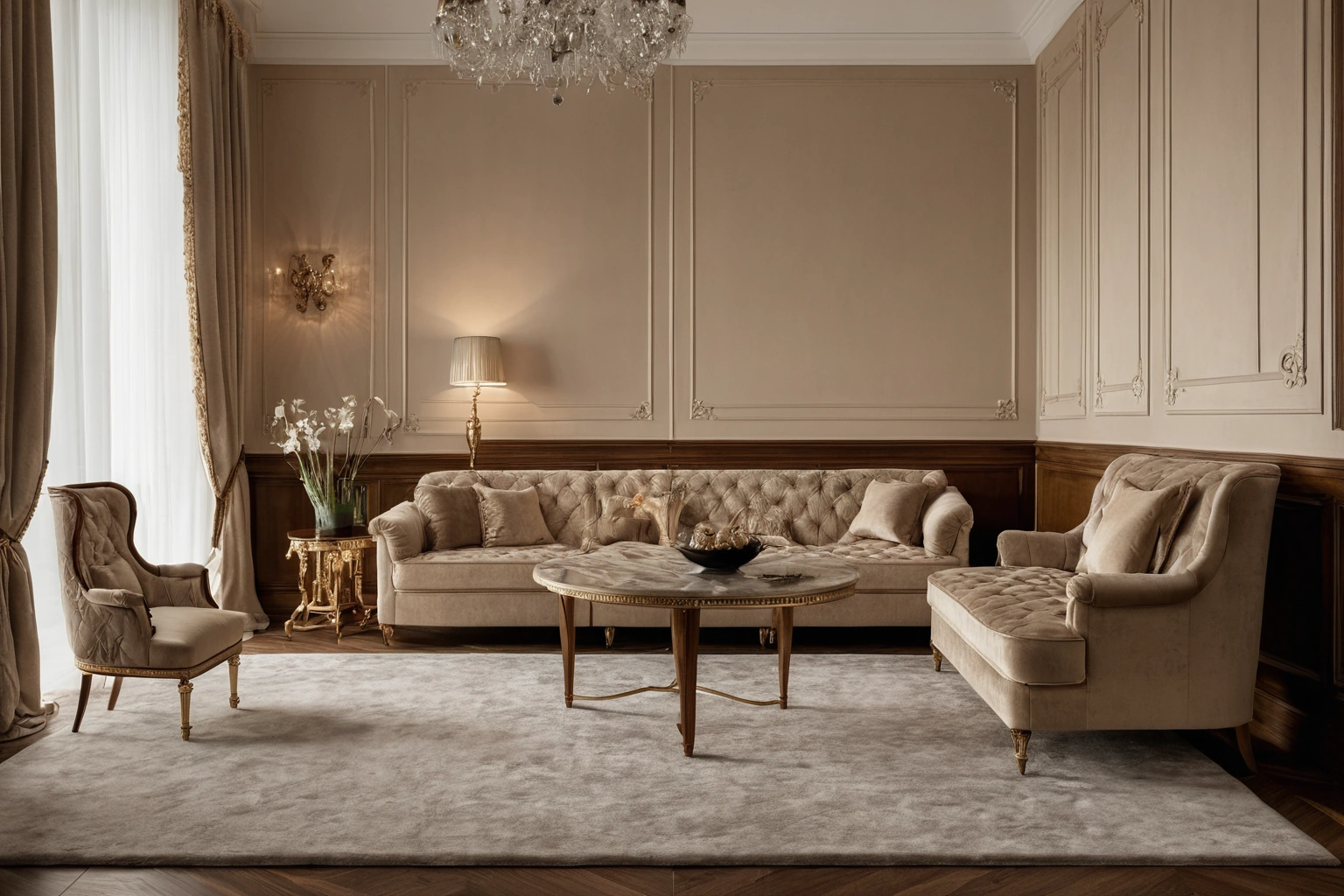
Marble, glass, plaster and polished concrete reflect nearly everything that hits them. Acoustic absorption turns sound energy into heat, which needs something for air to move through and rub against. Dense, hard surfaces reflect; soft, porous ones absorb. A room built from the first list and furnished thinly hands the sound back.
The consequence has a number attached. Reverberation time, RT60, is how long sound pressure takes to fall by 60 decibels after the source stops. Wallace Sabine’s equation still sets it: T60 = 0.161 V / Sa, where V is volume in cubic metres and Sa is total absorption in sabins. Volume sits in the numerator, absorption in the denominator. Bigger room, longer reverberation. More soft area, shorter. There is no third variable to design around.
Long reverberation does something specific to speech, and it is not loudness. It sustains steady-state vowels while masking stops, glides and the transitions between sounds, and those consonants carry most of the information. A hard room feels tiring rather than loud: intelligibility falls before volume becomes the complaint. A related practical reference is available in The Pinnacle of Luxury Italian Interior Design in 2025.
For scale, the American Academy of Audiology’s position on classroom acoustics cites ANSI/ASA S12.60: reverberation not exceeding 0.6 seconds unoccupied, background noise not exceeding 35 dBA. That is a school, not a drawing room, but it marks what “quiet enough to understand each other” costs.
Padding is a treble instrument, not a bass trap
A porous absorber works only when it is thick enough relative to the sound it must absorb. The rule from the acoustics literature: a porous layer needs a thickness on the order of a quarter of the wavelength, because that is where particle velocity is highest and viscous losses greatest. Sound travels at roughly 343 metres per second in air at 20 °C, so the arithmetic is fixed.
| Frequency | Wavelength in air | Quarter-wavelength | What lives there |
|---|---|---|---|
| 125 Hz | 2.74 m | 686 mm | Room boom, rumble |
| 250 Hz | 1.37 m | 343 mm | Lower voice fundamentals |
| 500 Hz | 0.69 m | 171 mm | The body of speech |
| 1 kHz | 0.34 m | 86 mm | Clarity |
| 2 kHz | 0.17 m | 43 mm | Consonants |
| 4 kHz | 0.09 m | 21 mm | Sibilance, cutlery, glare |
A typical padded wall carries 25 to 40 millimetres of wadding. That layer works hard from roughly 2 kHz up, exactly the band that makes a marble room sound brittle: the clatter, the sibilance, the edge on a raised voice. It does less through the mid-range and almost nothing at 125 Hz, where a quarter wavelength is 686 millimetres, and nobody builds a 686 millimetre wall. So padded walls do not fix a room’s acoustics. They take the glare off the top end, where the ear is least forgiving, which is the narrower claim worth paying for. An air gap behind the panel shifts useful absorption lower, moving the fabric towards where particle velocity peaks. A batten frame is an acoustic decision, not a fixing method. The wider project context is available from tllr.org.
A padded wall does not make a room quiet. It removes the hardness from the frequencies that make a hard room tiring, a smaller and more defensible promise.
Suppliers quote absorption as an NRC figure, the mean of the coefficients at 250, 500, 1000 and 2000 Hz, rounded to the nearest 0.05. Two limits are worth knowing first. It ignores everything below 250 Hz, precisely where a thin pad is weakest, so NRC flatters padding by construction. And reverberation-room measurement can return values above 1.0 through edge diffraction, a test artefact rather than more than total absorption. Ask for the octave-band data.
Why the relief earns its depth
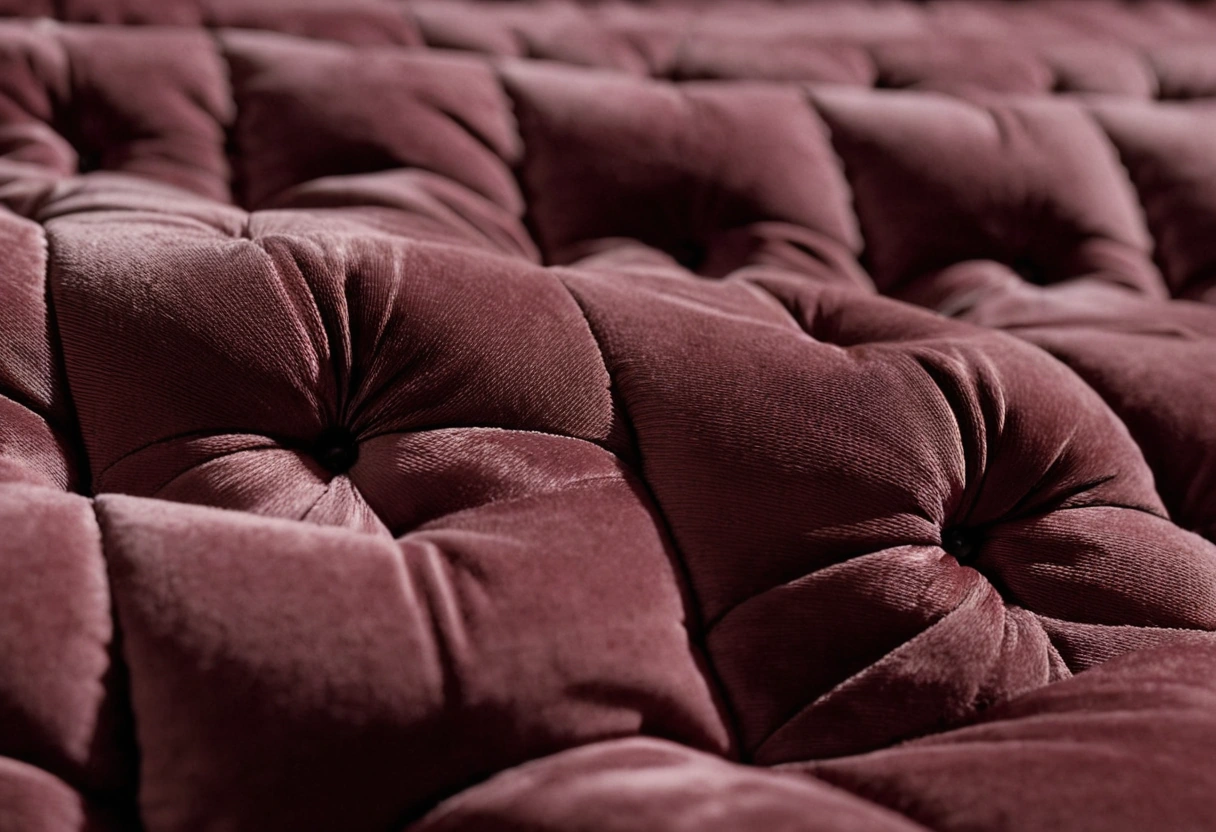
The quilted and sculpted panels do a second job. A flat absorber takes energy out. A modelled surface also scatters it, breaking a reflection into weaker ones spread across time and direction rather than returning one hard slap. Diffusion sits alongside absorption as a standard acoustic tool, and relief depth buys it. Further related coverage is collected in Blog.
The vocabulary comes from sculpture. Bas-relief reaches English from the Italian basso rilievo by way of the French bas-relief, both meaning low relief: an image with shallow depth, the kind used on coins. Sculptors grade it by projection, from sunk relief through low and mid-relief to high relief, where more than half the subject stands clear. Relief carving runs through Egypt, Assyria, Persia, Greece and Rome. Working it in wadding rather than stone is the recent part.
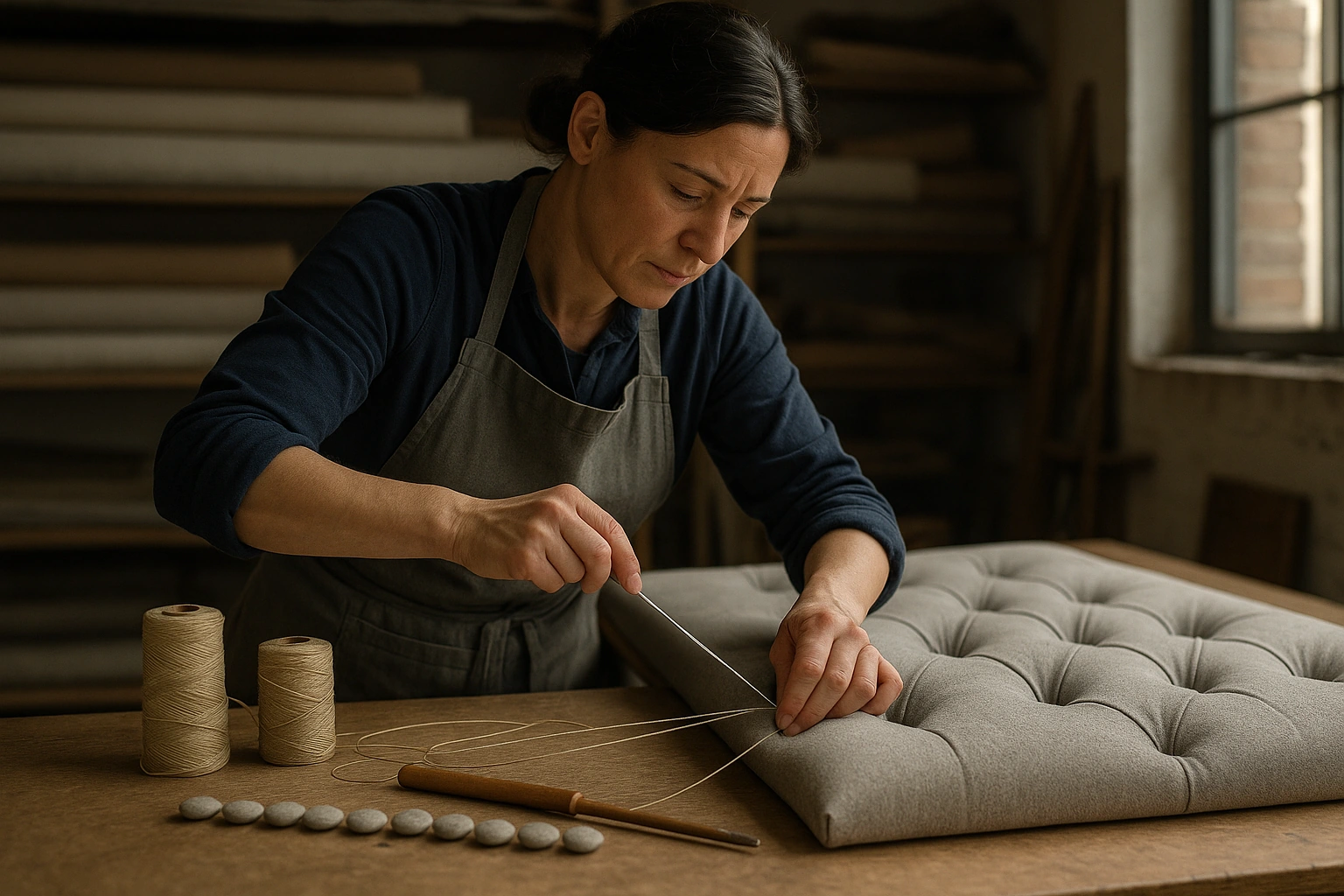
The buttoning has its own lineage. Deep buttoning, capitonné in French, began as engineering: a covered button pulled through the stuffing on twine kept loose fill from migrating inside the frame, and the diamond fold was the by-product. The first leather sofa with deep-buttoned quilted upholstery is believed to have been commissioned by Philip Stanhope, 4th Earl of Chesterfield, born 1694 and died 1773. The technique solved a stuffing problem and stayed for how it catches light.
Specifying it without regretting it
Fabric on a wall raises questions plaster never does. For the next stage of the brief, see About Us.
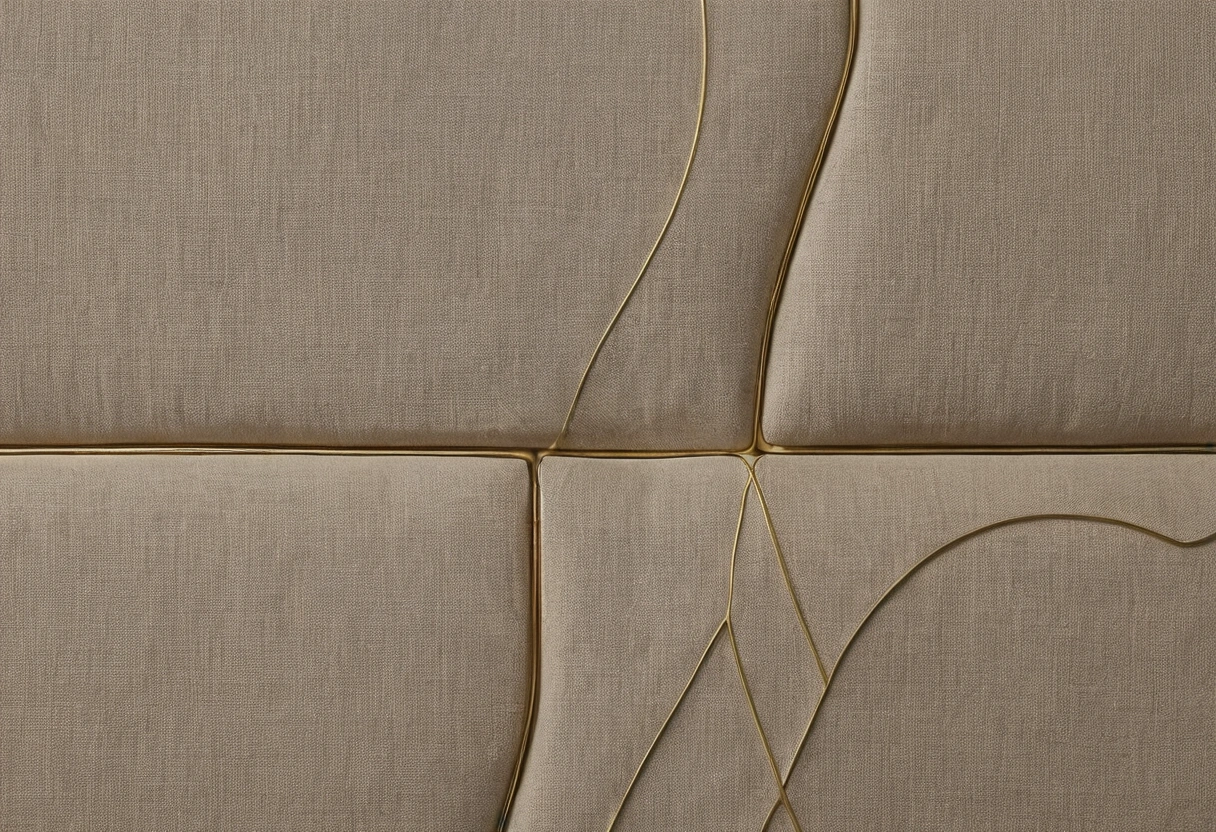
- Substrate first. The panel is a build-up: backing board, wadding, cover. What sits behind it governs the acoustics and the fire classification. Under EN 13501-1, products are rated A1 to F with s1–s3 for smoke and d0–d2 for flaming droplets, and a wall covering’s rating depends on the substrate it was tested on. A fabric result quoted without its substrate is not a result.
- Fill, then face. Absorption comes from the wadding and the air behind it. The cover helps only if it lets air through, so a tightly backed or coated fabric cancels the layer underneath.
- Plan the cleaning. Fabric holds dust and cooking aerosols. Specify removable, individually replaceable panels, clear of the extraction path.
- Treat the whole room. One padded wall facing bare marble still leaves a hard reflection path. Absorption works on total area, not gestures.
Those are commissioning questions, not shopping questions. Anyone building bespoke upholstered wall panelling should give the fill spec, the substrate the fire class was tested on and the octave-band data without being pushed.
- RT60
- Reverberation time: how long sound pressure takes to fall 60 dB after the source stops.
- Sabin
- The unit of total absorption: surface area times its absorption coefficient, summed over the room.
- NRC
- Noise Reduction Coefficient: the mean of the coefficients at 250, 500, 1000 and 2000 Hz.
- Capitonné
- Deep buttoning; covered buttons drawn through the stuffing on twine, forming a diamond fold.
- Diffusion
- Scattering a reflection instead of absorbing it. Relief depth does this; a flat pad does not.
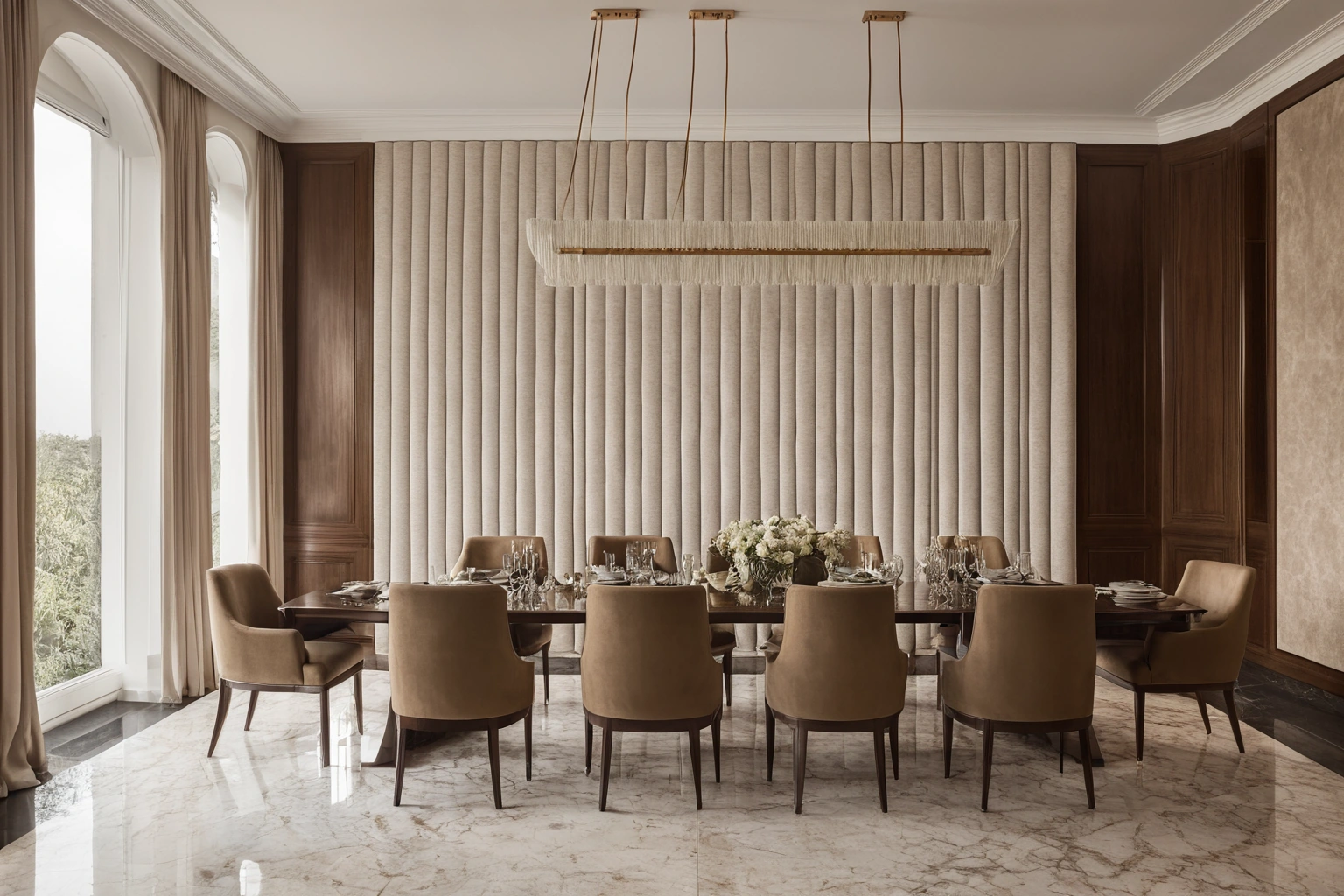
The mood part is real, and it is downstream of the physics rather than separate from it. A room reads as warm when the top end stops ringing and speech arrives once instead of three times. Add a surface that holds a shadow and light stops skidding across it. The 2026 fabric wall absorbs at the top, scatters across the middle and can do nothing about the bass. Specified with that understood, it earns its cost. Sold as a cure for a loud room, it disappoints by 686 millimetres.
0 Comments